In Nepal, one complete IVF cycle costs between NPR 3,00,000 and NPR 5,00,000, depending on the type of treatment required, the clinic you choose, your medication response, and whether advanced procedures such as ICSI or genetic testing are needed. This price covers the core cycle, consultations, monitoring scans, egg retrieval, laboratory fertilisation, and embryo transfer. Medications and add-on procedures are usually charged separately.
This guide explains every cost involved in IVF treatment in Nepal, what is and is not included in standard packages, how prices vary by treatment type, and what questions to ask your clinic before you begin.
What Is IVF and Who Needs It?
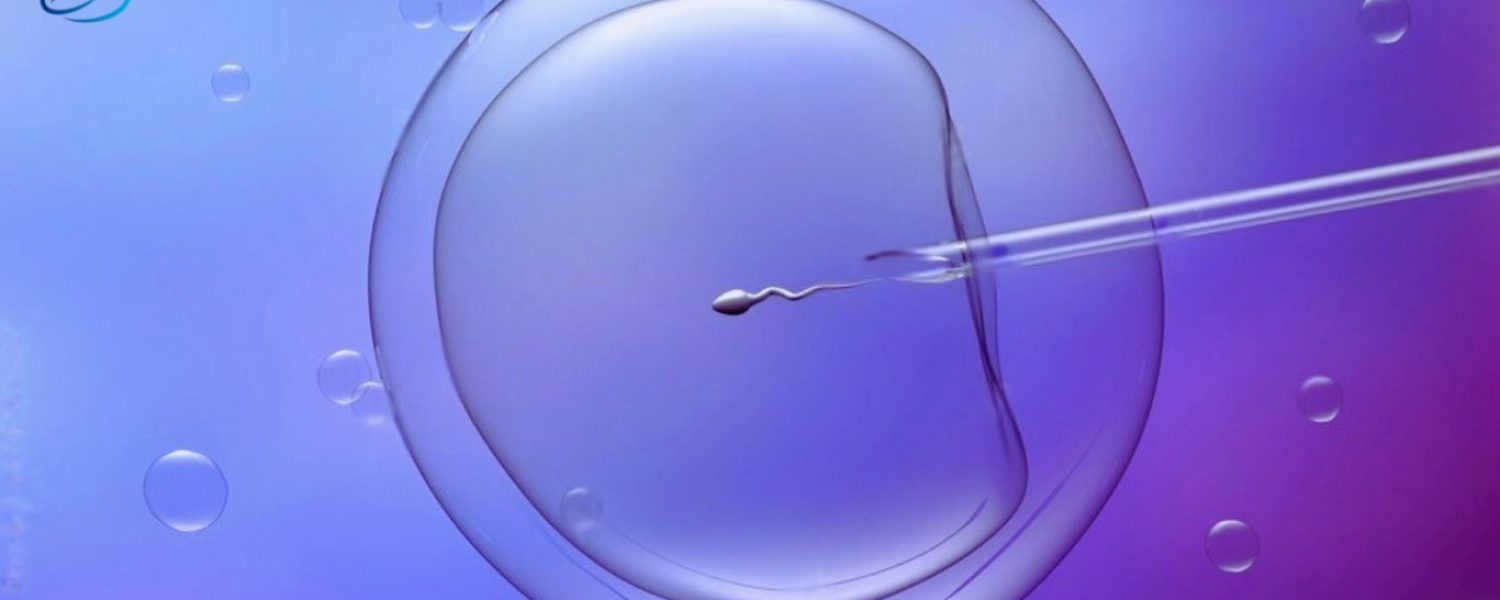
In Vitro Fertilisation (IVF) is an assisted reproductive technology in which eggs and sperm are combined outside the body in a controlled laboratory environment. Once fertilised, the resulting embryo is transferred into the woman’s uterus to establish a pregnancy.
According to the World Health Organization, approximately 1 in 6 people of reproductive age worldwide are affected by infertility. In Nepal, research published in peer-reviewed literature estimates the infertility prevalence at around 6% of couples of reproductive age, meaning a significant number of Nepali families require medical assistance to conceive.
IVF is typically recommended after simpler fertility treatments have not succeeded, or as a first-line option when there is a clear clinical reason such as blocked fallopian tubes, severe male factor infertility, or poor ovarian reserve. Before recommending IVF, fertility specialists will usually carry out an AMH test and baseline hormone blood panel to assess ovarian reserve, along with a transvaginal ultrasound (TVS) to evaluate the uterus and ovarian follicle count.
Looking for IVF treatment from a trusted IVF center in Nepal? Consult with our fertility specialists today to understand your treatment options, success rates, and personalised IVF plan.
IVF Price in Nepal – 2026
|
Treatment Type |
Estimated Cost (NPR) |
Notes |
|
Standard IVF (own eggs + own sperm) |
3,00,000 – 5,00,000 |
Core cycle; medications extra |
|
IVF with ICSI |
3,50,000 – 5,50,000 |
Recommended for male factor infertility |
|
Frozen Embryo Transfer (FET) |
1,00,000 – 1,50,000 |
Uses embryos from a previous cycle |
|
IVF with Donor Eggs |
5,50,000 – 6,50,000 |
Includes donor screening and compensation |
|
IVF with Donor Sperm |
3,50,000 – 4,50,000 |
Includes donor sperm sourcing and preparation |
|
Fertility medications (per cycle) |
30,000 – 1,50,000 |
Varies by individual response to stimulation |
|
ICSI (add-on if not in package) |
50,000 – 1,00,000 |
Added to base IVF cycle cost |
|
Embryo freezing (vitrification) |
30,000 – 60,000 |
First year storage usually included |
|
Annual embryo storage |
15,000 – 25,000 |
Ongoing cryopreservation fee |
|
PGT-A / PGD genetic testing |
80,000 – 1,50,000 |
Optional; per embryo tested |
Prices above reflect the general range across reputable fertility clinics in Kathmandu as of 2026. Individual costs will vary based on your specific treatment plan.
What Is Typically Included in a Standard IVF Package?
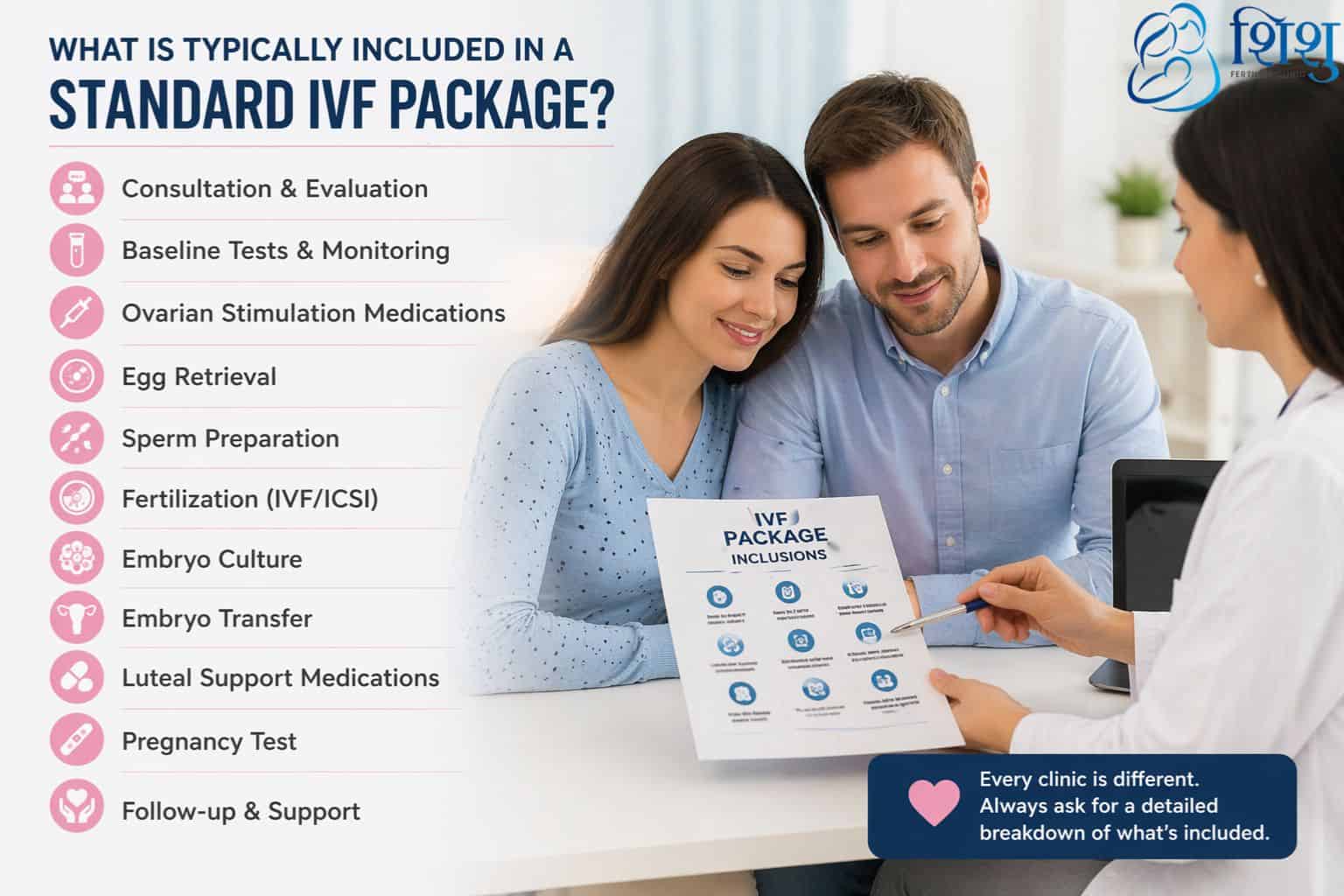
Understanding exactly what a quoted IVF price covers is essential before committing to a clinic. Most standard IVF packages in Nepal include the following:
Initial consultation and fertility assessment:
A meeting with the fertility specialist to review your medical history, recommend investigations, and outline a treatment plan. This is sometimes offered free of charge or at a nominal consultation fee.
Ovarian stimulation monitoring:
Multiple clinic visits over 10 to 14 days including blood hormone tests and ultrasound scans to track follicle growth and adjust medication doses accordingly.
Egg retrieval procedure:
A miimally invasive surgical procedure performed under mild sedation, in which mature eggs are aspirated from the ovaries using an ultrasound-guided needle. The procedure takes approximately 20 to 30 minutes.
Sperm preparation:
On the same day as egg retrieval, the male partner’s semen sample is processed in the laboratory to isolate the healthiest, most motile sperm for fertilisation.
Laboratory fertilisation and embryo culture:
Eggs and sperm are combined in the IVF laboratory, either through conventional insemination or ICSI. Embryo development is monitored daily by embryologists over three to five days.
Embryo transfer:
The best-quality embryo is placed into the uterus using a thin catheter under ultrasound guidance. This is a painless outpatient procedure.
Post-transfer support:
Follow-up consultations and progesterone supplementation to support the uterine lining during the implantation window.
What is generally NOT included:
fertility medications, ICSI (unless stated), embryo freezing, genetic testing (PGT-A/PGD), and any surgical sperm retrieval procedures. Always ask for an itemised quote before starting treatment.
Cost of Pre-IVF Investigations
Before beginning an IVF cycle, both partners will require a series of diagnostic tests to identify the underlying cause of infertility and ensure the body is ready for treatment. These are usually conducted separately from the IVF package cost.
|
Investigation |
Approximate Cost (NPR) |
|
AMH (Anti-Müllerian Hormone) test |
2,000 – 3,500 |
|
FSH / LH / Oestradiol blood panel |
1,500 – 2,500 |
|
Transvaginal ultrasound (TVS) |
1,500 – 2,500 |
|
Semen analysis |
1,000 – 2,000 |
|
Thyroid function tests (TSH, T3, T4) |
1,000 – 2,000 |
|
Infectious disease screening (HIV, Hepatitis B & C) |
2,000 – 3,000 |
|
Complete blood count and blood group |
1,000 – 2,000 |
|
Total pre-IVF investigations (approximate) |
15,000 – 30,000 |
Breakdown by IVF Treatment Type
Standard IVF (Own Eggs and Own Sperm)
This is the most straightforward form of IVF and is recommended when the female partner produces viable eggs and the male partner’s sperm count is within a functional range. The full cycle cost in Nepal ranges from NPR 3,00,000 to NPR 5,00,000, with medications on top.
This approach is most appropriate for: blocked or damaged fallopian tubes, ovulation disorders such as PCOS, unexplained infertility after failed IUI cycles, and mild endometriosis.
IVF with ICSI (Intracytoplasmic Sperm Injection)
ICSI is a laboratory technique in which a single sperm is injected directly into each mature egg rather than allowing natural fertilisation. It is recommended when there are concerns about sperm quality, count, or motility. To understand the full picture of male fertility before recommending ICSI, clinics typically request a detailed semen analysis, you can read more about male infertility assessment and treatment options to understand what is evaluated.
ICSI adds NPR 50,000 to NPR 1,00,000 to a standard IVF cycle. Total cost for IVF with ICSI: NPR 3,50,000 to NPR 5,50,000 plus medications.
Frozen Embryo Transfer (FET)
If a previous IVF cycle produced more embryos than were transferred, the surplus embryos can be vitrified (flash-frozen) and used in a subsequent cycle. FET is considerably less expensive than a fresh cycle because it does not require full ovarian stimulation and egg retrieval. Cost of a FET cycle in Nepal: NPR 1,00,000 to NPR 1,50,000, plus medications for uterine preparation.
FET also allows couples time between cycles to recover physically and emotionally, or to address any factors, such as uterine issues or thyroid imbalance, that may have affected the first cycle.
IVF with Donor Eggs
Donor egg IVF is recommended when a woman cannot use her own eggs due to poor egg quality, premature ovarian insufficiency, advanced maternal age, or a genetic condition she does not want to pass on. Donor eggs are typically sourced from anonymous, screened donors between 21 and 30 years old. The total cost in Nepal, including donor recruitment, medical screening, compensation, egg retrieval, and the recipient’s IVF procedure, ranges from NPR 5,50,000 to NPR 6,50,000.
An important clinical note: when donor eggs are used, success rates are determined primarily by the donor’s age and egg quality rather than the recipient’s age. This means donor egg IVF can produce significantly higher success rates for women over 40 compared to using their own eggs.
IVF with Donor Sperm
When the male partner has no sperm (azoospermia) or produces insufficient viable sperm even after medical treatment, donor sperm from an anonymous, screened donor can be used. Cost in Nepal: NPR 3,50,000 to NPR 4,50,000.
What Factors Affect the Total Cost of IVF in Nepal?
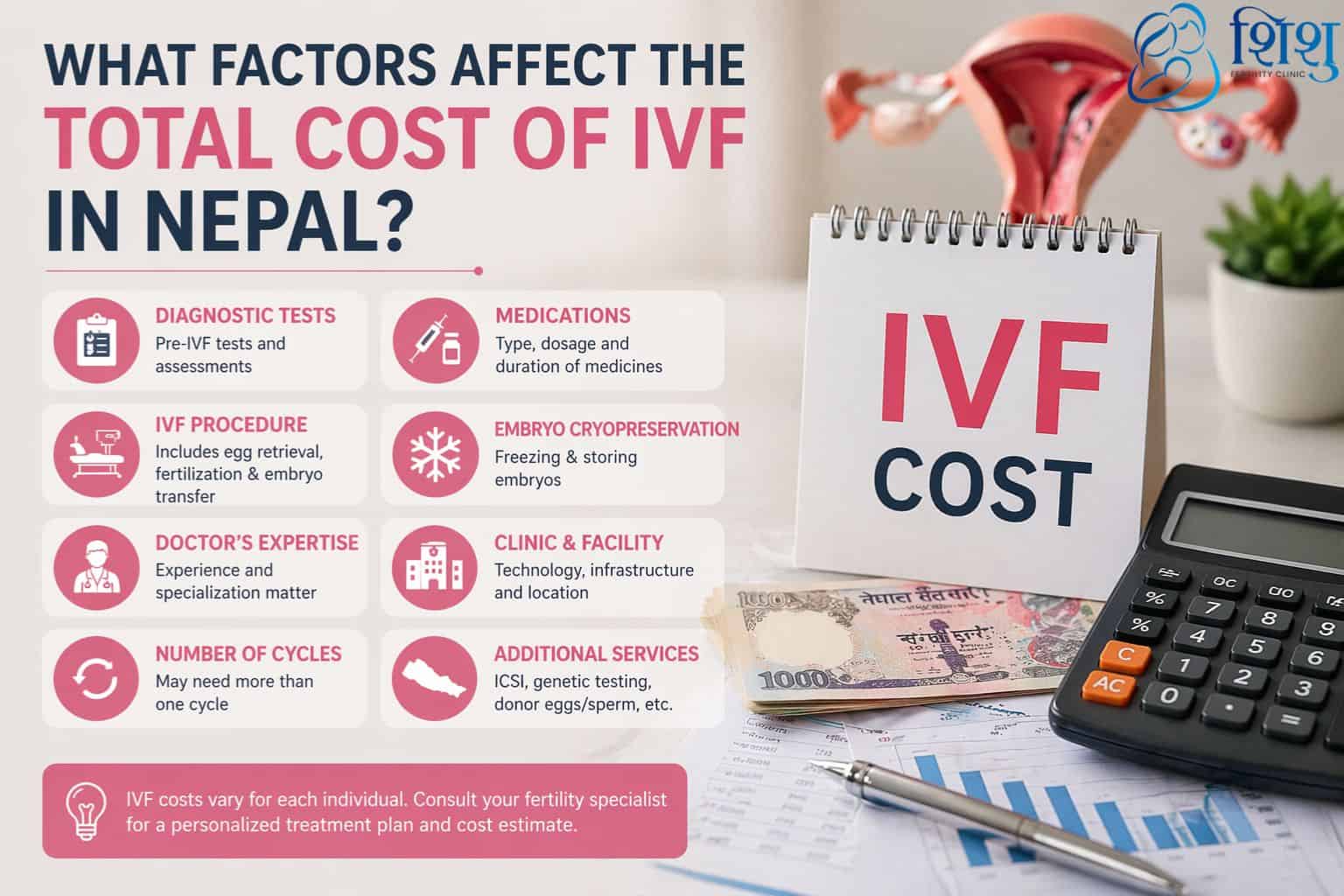
Here are the key factors that affect the cost of IVF in Nepal:
Patient age and ovarian reserve:
Younger women with a good AMH level and a healthy antral follicle count typically respond well to lower doses of stimulation medication, which keeps medication costs down. Women over 38, or those with diminished ovarian reserve, may require higher-dose protocols and sometimes multiple cycles, both of which increase total expenditure.
Number of cycles required:
A single IVF cycle achieves pregnancy in approximately 40–55% of women under 35, based on global data from the European Society of Human Reproduction and Embryology (ESHRE). Success rates decline with age, meaning some couples will need two or three cycles to achieve a live birth. Planning financially for more than one cycle is a realistic approach for women over 37.
Treatment protocol and medication response:
Different stimulation protocols (long protocol, antagonist protocol, mini-IVF) use different types and quantities of drugs. How your body responds also directly affects cost, women who respond poorly to standard doses may need higher-cost injections at higher quantities, while high responders need careful dose management to avoid complications like OHSS.
Need for advanced procedures:
ICSI, PGT-A genetic testing of embryos, assisted hatching, and endometrial receptivity testing (ERA) all add to the total. These are only recommended when clinically indicated, not as routine add-ons.
Embryo freezing decisions:
If stimulation produces a high number of mature eggs and multiple good-quality embryos develop, freezing surplus embryos is strongly advisable. This increases the upfront cost slightly but significantly reduces the cost of future attempts.
Why Is IVF More Affordable in Nepal Than in Western Countries?
Nepal’s IVF pricing is competitive within the South Asian region, and substantially more affordable than in the UK, USA, or Australia. The reasons are structural rather than reflecting any difference in clinical quality.
Medical infrastructure and specialist salaries in Nepal are calibrated to a lower-cost economy. Fertility medications, which are often the largest variable expense in an IVF cycle, are less heavily taxed and more affordably distributed in Nepal than in Western markets. Nepal has also developed a growing medical tourism ecosystem, attracting couples from India, Bangladesh, and Gulf states, which has encouraged competitive pricing and investment in laboratory technology across Kathmandu’s fertility clinics.
International IVF Cost Comparison – 2026
|
Country |
Average Cost Per IVF Cycle |
Approximate NPR Equivalent |
|
Nepal |
NPR 3,00,000 – 5,00,000 |
NPR 3,00,000 – 5,00,000 |
|
India |
INR 1,50,000 – 2,50,000 |
NPR 2,25,000 – 3,75,000 |
|
Thailand |
USD 4,000 – 6,000 |
NPR 5,40,000 – 8,10,000 |
|
United Kingdom |
GBP 5,000 – 8,000 |
NPR 8,50,000 – 13,60,000 |
|
United States |
USD 12,000 – 20,000 |
NPR 16,20,000 – 27,00,000 |
|
Australia |
AUD 8,000 – 15,000 |
NPR 8,60,000 – 16,10,000 |
Exchange rates are approximate and subject to change.
For Nepali residents, receiving treatment locally avoids the additional expense of international travel, accommodation, and the logistical complexity of managing a medical cycle abroad.
IVF Success Rates: What the Data Shows

Cost is only part of the picture. Understanding realistic success expectations helps couples plan financially and emotionally.