
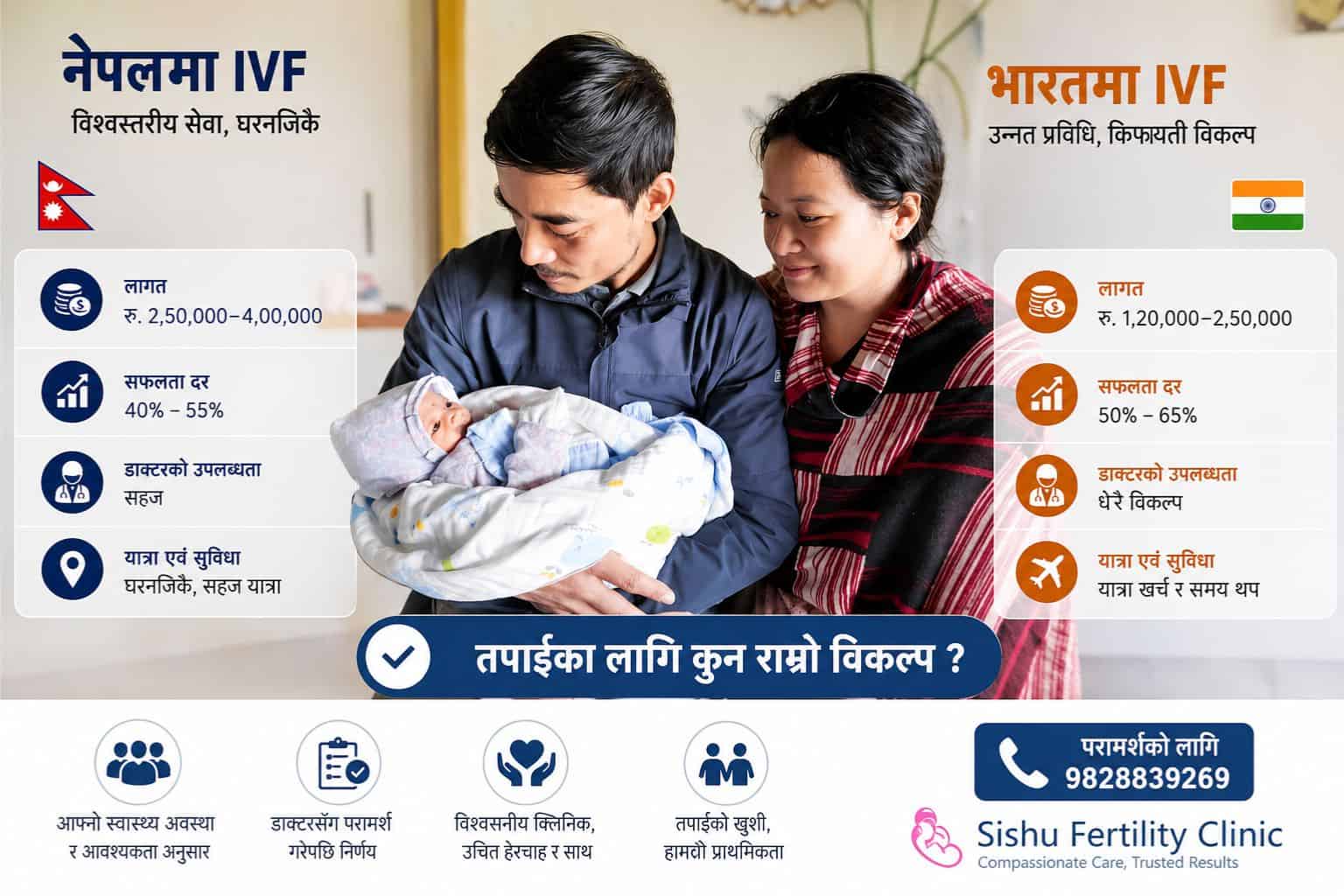
For most Nepali couples, Nepal is the better choice for IVF treatment.
The cost difference between the two countries is smaller than most people think. Once you add flights, accommodation, and living expenses in India, Nepal often works out equal or cheaper in total.
Nepal has accredited fertility clinics with trained specialists, modern laboratories, and competitive costs. You do not need to cross a border, manage foreign currency, or navigate a healthcare system in another country to get good IVF treatment.
That said, there are specific situations where India makes sense. This article explains both.
IVF Cost: Nepal vs India
This is usually the first question. So let us start here.
Cost in Nepal
A standard IVF cycle in Nepal costs between NPR 3,00,000 and NPR 5,00,000. This covers monitoring, egg retrieval, fertilisation in the lab, and embryo transfer. Fertility medications are usually additional and range from NPR 30,000 to NPR 1,50,000 depending on how your body responds.
Our focus is to provide personalized fertility care at a price that remains accessible for more couples across Nepal.
Contact Sishu Fertility Clinic to get the exact cost of your IVF treatment.
Estimated IVF Cost at Sishu Fertility
| Treatment | Estimated Cost |
|---|---|
| Standard IVF Cycle | Starting from NPR 3,00,000 |
| IVF with ICSI | Competitive pricing based on individual needs |
| Fertility Medications | Charged according to the treatment protocol |
| Consultation & Treatment Plan | Transparent before treatment begins |
Every couple’s treatment is different. After your fertility assessment, our team provides a written cost estimate so you understand your expected expenses before starting treatment.
You can see a full breakdown of IVF costs in Nepal, including what is and is not included in a standard package.
Cost in India
IVF cost in India in 2026 typically ranges from INR 1,20,000 to INR 2,50,000 per cycle for basic treatment. Depending on the condition, medicines, and add-ons like ICSI or embryo freezing, the cost can increase to INR 3,50,000 to INR 5,00,000 or more.
In NPR terms, that converts to approximately:
| Treatment | India Cost (INR) | India Cost (NPR approx.) | Nepal Cost (NPR) |
|---|---|---|---|
| Basic IVF cycle | 1,20,000 to 2,50,000 | 1,92,000 to 4,00,000 | 3,00,000 to 3,20,000 |
| IVF with ICSI | 2,00,000 to 3,50,000 | 3,20,000 to 5,60,000 | 3,50,000 to 4,00,000 |
| Fertility medications | 40,000 to 90,000 | 64,000 to 1,44,000 | 30,000 to 1,50,000 |
| IVF with donor eggs | 3,50,000 to 6,00,000 | 5,60,000 to 9,60,000 | 5,50,000 to 6,50,000 |
Exchange rate: 1 INR ≈ 1.60 NPR (approximate, April 2026)
What do the Numbers Mean?
The basic IVF cycle looks cheaper in India on paper. But two things change that picture quickly.
First, Indian clinics often quote a base price that excludes medications, ICSI, monitoring scans, and consultations. Consultations and diagnostic tests are not included in most IVF packages in India, and medications require separate payment. Once you add everything, the total cost in India often ends up similar to Nepal or higher.
Second, treatment in India requires you to travel. And travel costs are real.
The Hidden Cost of Going to India
This is what most cost comparisons leave out.
A standard IVF cycle requires multiple visits over 4 to 6 weeks. You need to be near the clinic during ovarian stimulation, every 2 to 3 days for monitoring. You need to be there for egg retrieval. For embryo transfer. For the pregnancy test.
If you are doing this from Nepal, add up:
- Return flights or bus tickets to your India clinic city (Lucknow, Delhi, Patna, Varanasi)
- Hotel or rental accommodation for 4 to 6 weeks
- Daily food and transport in a foreign city
- Currency exchange losses
- Time off work for both partners
- The stress of managing a medical procedure in an unfamiliar place
For most couples from Kathmandu, Chitwan or Dang, travelling to a city like Delhi adds NPR 80,000 to NPR 1,50,000 in travel and living costs per cycle. Couples from Kathmandu face similar logistics.
When you add those costs, India stops looking cheaper.
Success Rates: Is India Better?
This is the more important question. And the honest answer is no, not significantly.
According to ESHRE global IVF registry data, live birth rates per IVF cycle are approximately:
| Age Group | Global IVF Average |
|---|---|
| Under 35 | 45 to 55% |
| 35 to 37 | 32 to 40% |
| 38 to 40 | 20 to 26% |
| Over 40 (own eggs) | Under 15% |
IVF success rates in India are 50 to 70% for women under 35, 40 to 50% for women between 35 and 40, and 30 to 35% for women over 40.
These numbers are comparable to what accredited fertility clinics in Nepal report. The difference is not in the country. It is in the individual clinic. A well run clinic in Chitwan will produce better results than a poorly run clinic in Delhi, and vice versa.
What actually affects your success rate is not which country you choose. It is your age, your ovarian reserve, your diagnosis, the quality of the lab, and the experience of the embryologist managing your cycle.
Before choosing any clinic in either country, ask for their live birth rate by age group specifically. Not their overall success rate. Not their clinical pregnancy rate. The live birth rate is the only number that tells you how many couples actually took home a baby.
If you have not yet had your AMH test and hormone panel done, that is the starting point for understanding your personal chances before comparing any clinic numbers.
Medical Quality: A Fair Comparison
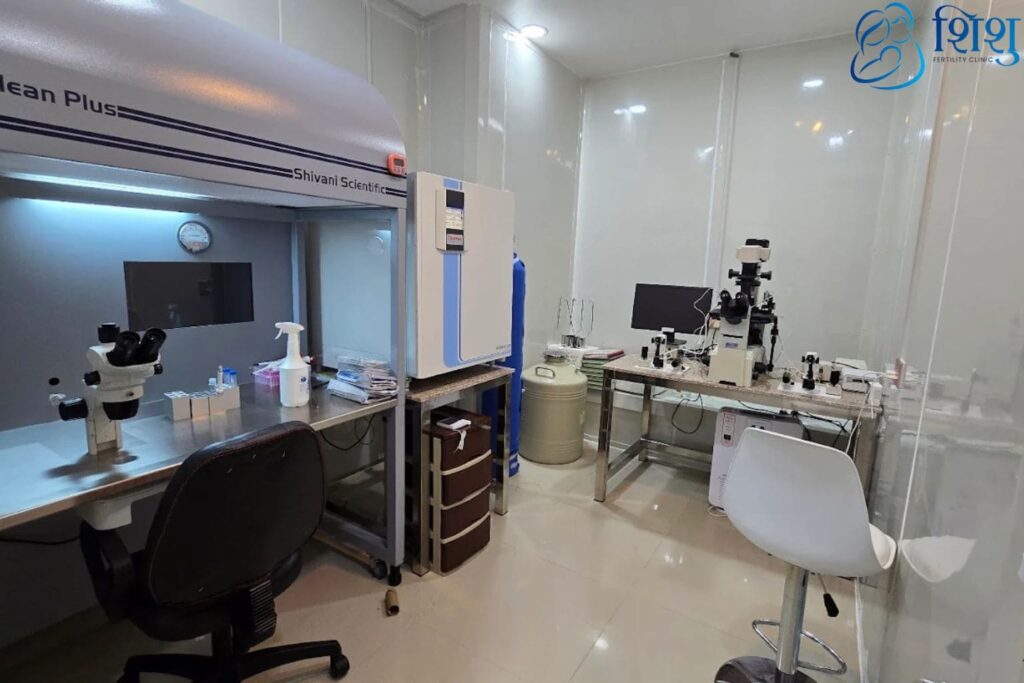
Some people assume Indian clinics have better technology because India is bigger. That assumption needs challenging.
Nepal has fertility clinics that use the same laboratory equipment, stimulation protocols, and embryology techniques as reputable Indian clinics. The technology used in modern IVF labs, including incubators, ICSI equipment, and vitrification systems, is imported internationally by clinics in both countries.
The difference in quality comes down to the individual clinic, not the country.
What determines quality in any clinic, Nepal or India:
- Does the clinic have a dedicated on site IVF laboratory?
- Who is the lead embryologist and how many cycles have they performed?
- Does the same specialist manage your case from start to finish?
- Is the stimulation protocol individualised based on your AMH and AFC, or is one standard protocol used for everyone?
- What is the clinic’s fertilisation rate per cycle?
These questions reveal more about a clinic’s quality than its country of origin.
When India Might Make Sense
There are genuine situations where going to India for IVF is the right call.
You need a highly specialised procedure that is not available in Nepal. Some advanced techniques like PGT-M (genetic testing for specific inherited conditions) or certain surgical interventions may not yet be available at all fertility clinics in Nepal. If your case requires something very specialised, India’s larger fertility hubs offer more options.
You have already started treatment in India. If you began your investigations or consultations at an Indian clinic and have frozen embryos there, continuing in India makes more practical sense than transferring records and embryos across borders.
You have a complex diagnosis requiring a second opinion from a high volume centre. Clinics in Delhi and Mumbai that perform thousands of cycles per year have exposure to rare and complex cases that smaller clinics see less frequently. For genuinely unusual diagnoses, a second opinion from a high volume centre can be valuable.
You are already in India for other reasons. Some Nepali couples are based in India for work or education. For them, accessing fertility treatment there is simply more convenient.
When Nepal Is the Better Choice
For the majority of Nepali couples, treatment in Nepal is the practical and financially sensible option.
You save on travel costs. As shown above, the real cost difference between Nepal and India is small when you account for travel and accommodation. For most couples, Nepal ends up equal or cheaper in total.
You stay near your support system. IVF is emotionally demanding. Being at home, near family, sleeping in your own bed, and speaking your own language makes the process easier to manage.
You do not need to manage treatment logistics across a border. Scheduling monitoring appointments, coordinating with a clinic remotely, and dealing with a foreign healthcare system adds stress that is simply absent when you are treated locally.
Follow up care is easier. After embryo transfer, you continue progesterone support and follow up monitoring for two weeks. Doing this at a clinic near your home is far simpler than managing it from Nepal while your treating clinic is in another country.
What About Male Infertility?
Male factor infertility is present in nearly half of all infertility cases. If a semen analysis shows low sperm count, poor motility, or no sperm at all, the treatment pathway matters as much as the country.
Both Nepal and India offer IVF with ICSI, which is the primary treatment for male factor infertility. PESA for obstructive azoospermia is also available in accredited Nepali clinics.
If your case involves male factor infertility, the relevant question is not which country to go to. It is whether your chosen clinic assesses and treats both partners properly from the first visit.
A Side by Side Summary
| Factor | Nepal | India |
|---|---|---|
| Basic IVF cost | NPR 3,00,000 to 5,00,000 | NPR 1,92,000 to 4,00,000 (INR equivalent) |
| Total cost including travel | Lower for Nepali couples | Higher when travel added |
| Success rates | Comparable to global averages | Comparable to global averages |
| Technology and lab quality | Varies by clinic | Varies by clinic |
| Language and communication | Nepali or Hindi | Hindi or English |
| Support system access | Full access | Limited |
| Follow up care | Easy | Requires travel or coordination |
| Legal framework | IVF legal for married couples | IVF legal, more regulatory clarity |
| Visa and border requirements | None | Visa required for longer stays |
| When to consider | Most Nepali couples | Complex cases, existing treatment, based in India |
The Conclusion
India is not automatically better than Nepal for IVF. It is different.
For most Nepali couples, a well chosen clinic in Nepal offers the same standard of care, comparable success rates, and a significantly simpler treatment experience. The cost difference, once travel is included, is small enough that it rarely justifies crossing a border.
India makes sense for specific situations. Complex or rare diagnoses. Existing treatment that has already started there. Access to procedures not yet widely available in Nepal.
The most important decision is not Nepal versus India. It is which specific clinic, in whichever country, has the right team, the right laboratory standards, and a track record of honest communication with their patients.
If you are based in Nepal and want to understand your personal fertility situation before making any decisions, a consultation at Sishu Fertility Clinic in Chitwan or Dang gives you a clear starting point. Both partners assessed together. Written cost estimate provided. No pressure to decide at the first appointment.
Sishu Fertility Clinic serves patients from across Nepal including Kathmandu, Pokhara, Butwal and Bhairahawa, with clinic locations in Bharatpur, Chitwan and Ghorahi, Dang.
Sources:
1. ESHRE, European Society of Human Reproduction and Embryology Global IVF registry data, success rates by age group https://www.eshre.eu/
2. World Health Organization, Infertility Fact Sheet Global infertility prevalence statistics https://www.who.int/news-room/fact-sheets/detail/infertility
3. Dr. Hrishikesh Pai, IVF Cost in India 2026 India IVF cost data and breakdown used in the comparison table https://drhrishikeshpai.com/blog/what-is-ivf-cost-in-india-2026/